


CERTIFICATIONS
Applied Filters
SELF-PRIMING PUMPS
Home > Positive Displacement Technology > Diaphragm Pumps > Self-Priming Pumps
A self-priming pump can lift fluid from below the pump's position on a dry start — no manual priming, no foot valves, no flooded suction line required. For most industrial fluid transfer, dewatering, and drum unloading work, self-priming capability isn't a nice-to-have; it's the difference between a pump that runs reliably and one that fails to start when conditions change.
Air-operated double diaphragm (AODD) pumps are inherently self-priming. Unlike centrifugal pumps, which depend on a flooded suction or external priming systems to develop pressure, AODD pumps create their own suction through diaphragm displacement on every stroke.

A self-priming pump can evacuate air from the suction line and create the vacuum needed to draw fluid up to the pump on its own — without external assistance or the need for the suction side to be pre-filled with liquid. The capability matters because real-world fluid transfer rarely happens with the pump conveniently flooded at all times. Suction lines empty between cycles. Drum levels drop. Sumps and tanks fill and empty. A pump that can't self-prime requires manual intervention, foot valves that fail, or priming systems that add cost and failure points.
Self-priming pumps come in two broad categories: pumps with self-priming features added (e.g., centrifugal pumps with priming chambers, jet assemblies, or vacuum-assist systems) and pumps that are inherently self-priming by design (e.g., positive displacement pumps like diaphragm and peristaltic). The inherent self-primers tend to be more reliable because the capability is built into the pump's physical design rather than added as a supporting system that can fail.
AODD pumps work by alternately flexing two flexible diaphragms inside opposing pump chambers. As compressed air pushes one diaphragm out, fluid discharges through a check valve. As the same air movement pulls the other diaphragm in, that chamber expands — creating suction that draws fluid in through the inlet check valve. This suction-creating motion occurs in every cycle, whether the pump is full of fluid, partially full, or completely dry.
The result: an AODD pump can start dry, evacuate air from a suction line to a vertical lift of roughly 20 feet (depending on configuration), and begin moving fluid without manual priming. Once primed, the pump continues operating normally. If the suction line empties again between cycles, the pump re-primes itself automatically.
This is fundamentally different from how centrifugal pumps create flow. A centrifugal pump uses an impeller to add velocity to the fluid; if there's no fluid in the impeller chamber, there's nothing to accelerate, and the pump won't prime without a flooded suction or a separate priming system. That's why centrifugal pumps marketed as "self-priming" typically have additional chambers, jet assemblies, or vacuum-assist systems bolted on — they're solving a problem that AODD pumps don't have in the first place.
Self-priming matters in any application where the pump's suction conditions change during normal operation. Specific cases where it's essential:
Drum and tote unloading: fluid level drops as the container empties; the pump must re-prime as the suction line fills with air.
Dewatering and sump applications: submersible slurry pumps work with intermittent fluid availability as water levels rise and fall
Self-priming transfer pumps: fluid transfer from below-grade tanks, vaults, or remote storage where flooding the suction is impractical
Tank-to-tank transfer with elevation differences: the pump may need to lift fluid from a lower source to a higher destination
Fluid handling in remote or hazardous locations where manual priming isn't safe or practical
Backup or intermittent pumping applications where the system can't guarantee a flooded suction at startup
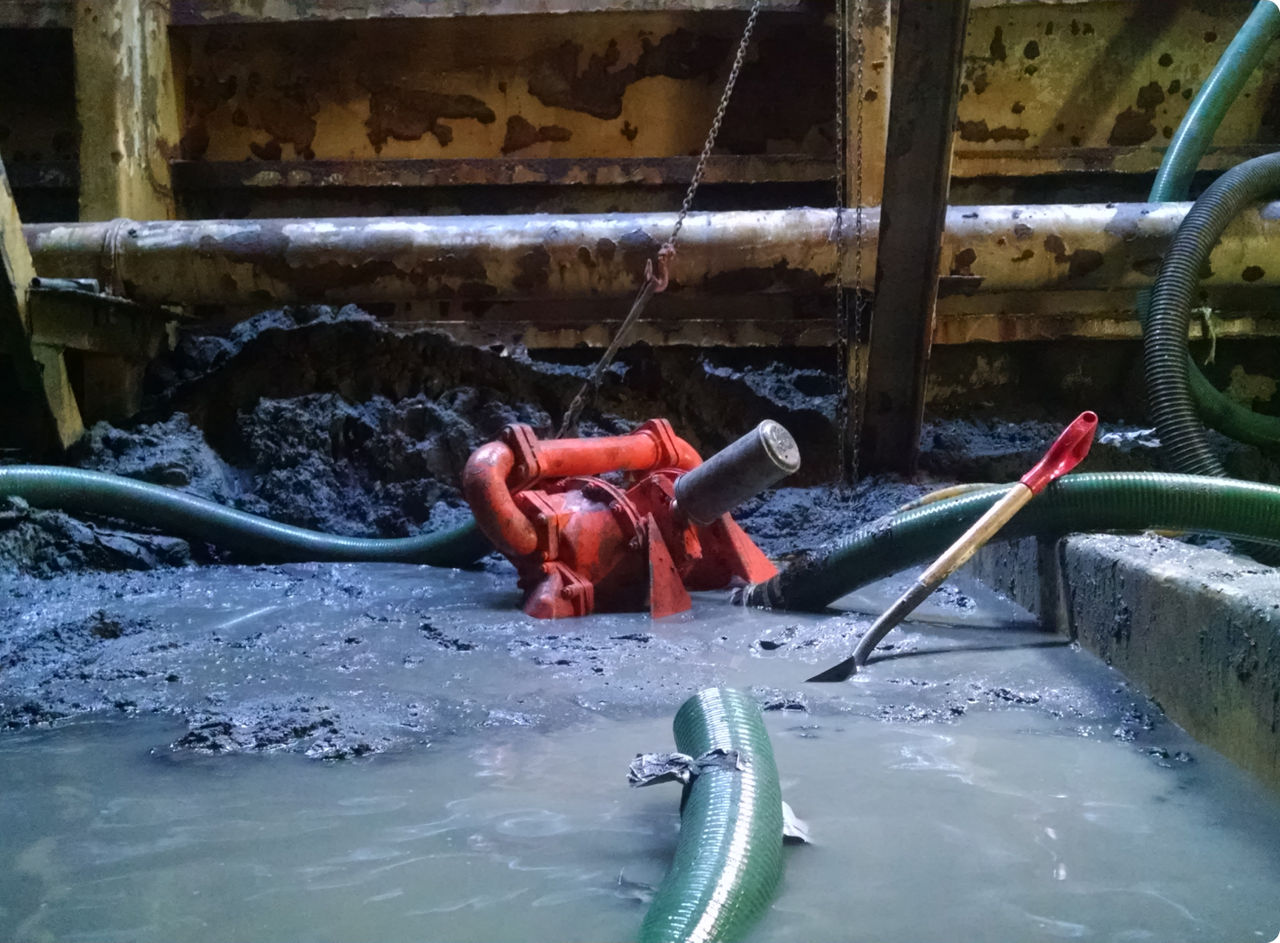
A Wilden® AODD from PSG® operating in a slurry environment where self-priming capabilities are necessary.
If you've been comparing self-priming centrifugal pumps for an industrial application, AODD diaphragm pumps are worth evaluating side-by-side. Centrifugal self-primers solve the priming problem with auxiliary systems such as priming chambers, recirculation features, or vacuum-assist setups. These work — but they add cost, mechanical complexity, and failure points.
AODD self-priming is structural. There's nothing extra to fail because there's nothing extra in the first place. Beyond self-priming itself, AODD pumps add capabilities that centrifugals can't match: handling solids and slurries without erosion, running dry without damage, intrinsic safety in hazardous environments (no electricity), and seal-less operation. The trade-off is flow rate — centrifugals can move more volume at higher discharge pressures.
For most industrial transfer, dewatering, drum unloading, and chemical diaphragm pump work, AODD pumps are the better fit. For very high-volume, low-viscosity transfer in clean fluids, centrifugals retain the edge.
For a deeper comparison specific to AODD and centrifugal pumps, see the blog post on why "either works" may actually be wrong.
The PSG® Store carries the full Wilden® and All-Flo™ AODD lineup — every pump in the catalog is self-priming by design. There's no separate "self-priming line" because the entire AODD lineup is self-priming. Both brands ship from the PSG® Store with the manufacturer's warranty and access to genuine diaphragm pump parts.
Use the filters above to narrow the catalog, or use the pump finder if you need help matching a self-priming AODD pump to your specific application requirements. In-stock pumps ship the same day; non-stocked configurations ship directly from the manufacturer.
Need Assistance? Call our pump experts at (616)-407-7103 or complete a contact us form.


© 2026 PSG Dover All Rights Reserved
